



 English
 Français
 Deutsch
 Italiano
 Português
 Русский
 Español
 简体中文
简体中文 हिन्दी
 日本語
日本語

After a presentation dogged by muffled audio and then climate-change protesters, Fed Chair Jerome Powell finally got his message across, which was, basically, that he didn’t have one.
It was “historically unusual” that inflation has come down without unemployment rising. Geopolitical tensions are “highly uncertain.” In the Q&A, he talked of the idea that the 20 years before the pandemic may have been a perfect storm of disinflation that may now yield to a period of more supply shocks. “Are we going into such a… I don’t know.” At the margin, while the rise in long-term yields could reduce the need for rate hikes, “that remains to be seen,” Powell said.
While Powell’s views on the future were muddy, the past shows an aggressive tightening that has left the effective federal funds rate at 5.33%, above the average of 4.6% that it’s been dating back to 1954.
“Rising interest rates operate negatively on most assets and the economy at large with a lag. These changes are not temporary, and there will be interesting and painful consequences that naturally befall a world that coasted for over a decade on low rates and free money,” said Jeffrey Bronchick, who runs the Cove Street Capital Small Cap Value Fund, in a recent letter to clients.
His fund is coming off a difficult third quarter in which it dropped 7%, though it’s had a strong year by small-cap standards, up 7% through Thursday.
The failure of an antenna after a successful satellite launch by ViaSat
VSAT,
did not go down well. “While most costs are fully insured, the math on the actual cashflow produced by a giant increase in service capacity is pushed out to the right by at least 18 months. That is not a good thing,” he says. Then Inmarsat, which ViaSat bought in May for $7.3 billion, suffered a likely total failure after launch, the first in 40 years. Still, he calls the stock “stupid, stupid cheap” with immense strategic value. He said it’s a very good bet from here, but not the firm’s best, highest-conviction one.
Another what he calls an “off spreadsheet” event occurred after the hack at MGM Resorts
MGM,
which weighed on media conglomerate IAC
IAC,
the 18% owner. Dotdash Meredith, another IAC holding, “remains mired in an ad recession as it continues its work onboarding the Meredith print properties to its digital monetization machine.” Still, he says IAC is trading at $125 million above its combined cash, MGM and Angi
ANGI,
positions, and he said he’s added to the position.
E.W. Scripps
SSP,
meanwhile, suffered from the auto strikes as well as general concerns about the economy. “We think legacy TV has much longer life to it than fancy talk suggests, and despite obvious exposure to the cyclicality of the advertising business at large, Scripps is a cash gusher that is rapidly paying down debt from a series of acquisitions that were enabled under the prior administration. Pick your favorite math, but ours suggests that free cashflow to pay down debt is creating 30% annualized increases in equity value at current levels,” he says.
The broader view is that the market is not rewarding small caps at the moment. He said that’s ultimately a good thing. “That has created real opportunities in real businesses with real values that are less affected by the fads of the day,” said Bronchick.
The markets
The S&P 500
SPX
has dropped over 2% the last three sessions, and stock futures
ES00,
NQ00,
were pointing to more of the same for Friday. The yield on the 10-year Treasury
BX:TMUBMUSD10Y
has backed away from the very-nearly-almost 5% level. Gold futures
GC00,
rose.
For more market updates plus actionable trade ideas for stocks, options and crypto, subscribe to MarketDiem by Investor’s Business Daily.
The buzz
Israel carried out air strikes on Gaza as its defense minister told troops that they will soon see the region “from the inside,” which suggests an imminent ground invasion.
SolarEdge Technologies
SEDG,
warned on profits due to a slowdown in solar-power installations in Europe, news that also hurt rivals including Enphase Energy
ENPH,
and SunPower
SPWR,
Friday will see the expiration of some $2.5 trillion of options contracts.
Best of the web
Apple balked at Jon Stewart tackling topics including China and artificial intelligence, according to the New York Times.
Nvidia
NVDA,
CEO Jensen Huang tells a podcast he wouldn’t have started the company had he known what he does now.
The average American family can be called millionaires.
Top tickers
Here are the most active stock-market tickers on MarketWatch as of 6 a.m. Eastern.
| Ticker | Security name |
|
TSLA, |
Tesla |
|
NVDA, |
Nvidia |
|
AMC, |
AMC Entertainment |
|
GME, |
GameStop |
|
NIO, |
Nio |
|
AAPL, |
Apple |
|
NFLX, |
Netflix |
|
MULN, |
Mullen Automotive |
|
AMZN, |
Amazon.com |
|
ICU, |
SeaStar Medical |
The chart
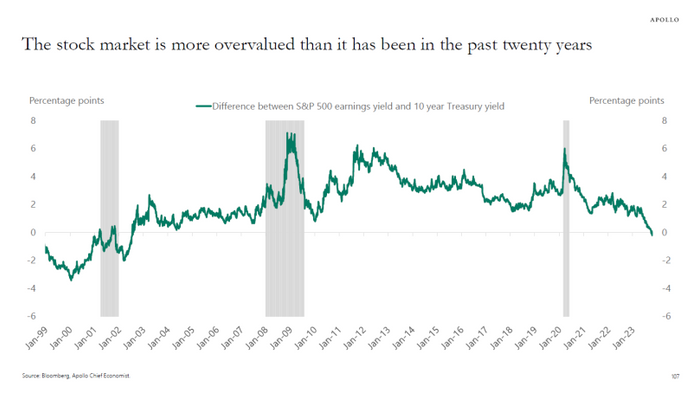
Whether looking at trailing or forward earnings forecasts, stocks are now more overvalued compared to bonds that they have been in 20 years, says Torsten Slok, chief economist at Apollo Global Management. That conclusions is made using the earnings yield — earnings to price — subtracted by the yield on the 10-year Treasury.
Random reads
The Van Gogh museum had the bright idea to give out Pokemon cards, in celebration of the artist’s ties to Japan. It was too popular.
The latest misfortune to befell Wall Street — back-to-office mandates precluding the opportunity to use second homes in Florida.
A man posed as a mannequin to steal jewellery after closing time.
Need to Know starts early and is updated until the opening bell, but sign up here to get it delivered once to your email box. The emailed version will be sent out at about 7:30 a.m. Eastern.
Listen to the Best New Ideas in Money podcast with MarketWatch financial columnist James Rogers and economist Stephanie Kelton.
Read the full article here