



 English
 Français
 Deutsch
 Italiano
 Português
 Русский
 Español
 简体中文
简体中文 हिन्दी
 日本語
日本語
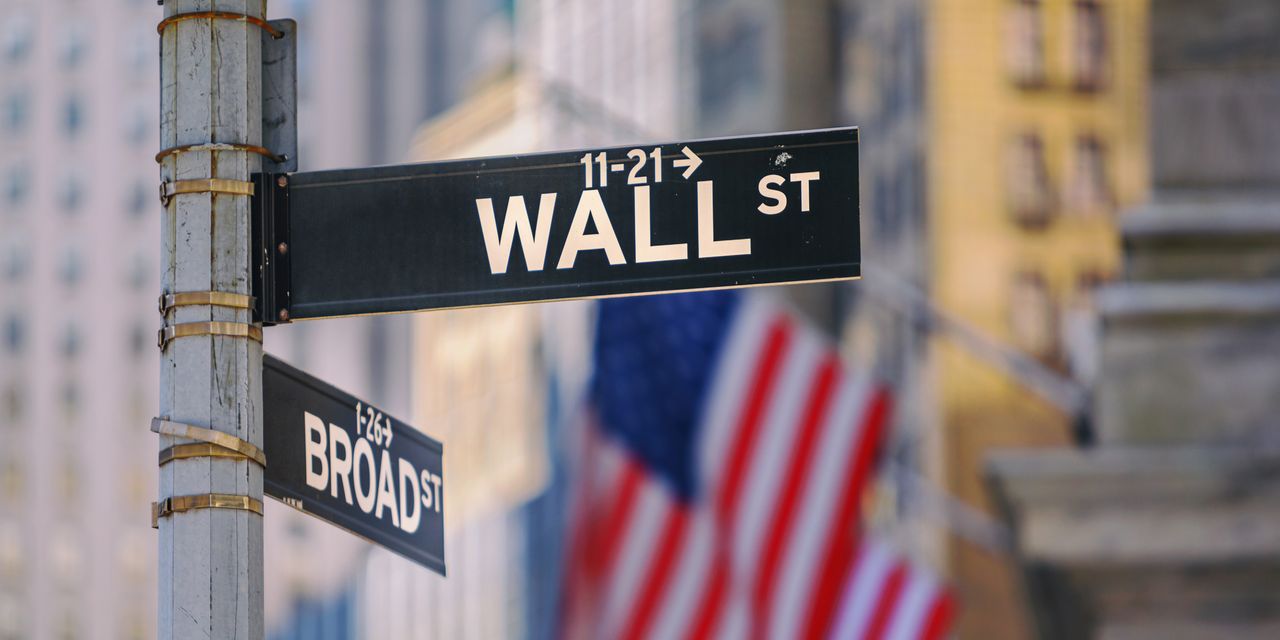
U.S. stocks finished higher on Monday, with Dow industrials eking out a gain in the final hour of trading, as investors shook off worries about China’s property sector and a possible resurgence of U.S. inflation.
How stocks traded
-
The Dow Jones Industrial Average
DJIA
toggled between slight gains and losses before ending up by 26.23 points, or less than 0.1%, at 35,307.63. It’s ended higher for three straight sessions. -
The S&P 500
SPX
closed up by 25.67 points, or 0.6%, at 4,489.72. -
The Nasdaq Composite
COMP
finished up by 143.48 points, or 1.1%, at 13,788.33.
The S&P 500 and Nasdaq Composite logged back-to-back weekly losses on Friday, while the Dow bucked the trend to post a 0.6% weekly gain.
What drove markets
Stocks ended higher, despite worries about China’s property sector weighing on appetite for risky assets around the world earlier in the day. Country Garden Holdings Co.
2007,
one of China’s biggest home builders, saw its shares plunge to another record low in Hong Kong trading on news it was suspending trading for at least 10 onshore bonds. The news added to fears about the health of the world’s second-biggest economy. Hong Kong’s Hang Seng
HK:HSI
closed down by 1.6%.
See: Country Garden’s stock slumps 18% after Morgan Stanley downgrade and bond suspension
Concerns about a possible return of U.S. inflation also were in focus over much of Monday’s session, with rising gas prices adding to concerns in the months ahead. According to AAA, the national average price of regular gasoline is $3.851 a gallon as of Monday — up from $3.848 on Sunday, $3.829 a week ago, and $3.566 a month ago.
Read: Why ‘stunning’ jump in jet fuel, diesel prices may complicate Fed’s inflation fight in months ahead
Last Thursday’s consumer-price index report for July showed underlying core inflation easing over the past 12 months to 4.7% from 4.8%, and wasn’t enough to put a decisive end to worries about price gains. Then, on Friday, the July producer-price index came in hotter-than-expected.
“From our point of view, the market has started worrying about inflation again,” said Chris Zaccarelli, chief investment officer for Independent Advisor Alliance in Charlotte, N.C., which manages roughly $10 billion in assets. “The feeling had been that inflation was in the rearview mirror and that we were past this, but there are now some concerns that inflation is stickier than expected. We’re seeing higher rates in the bond market,” which impacted the stock market earlier on Monday.
Via phone, Zaccarelli said that “specifically, within the stock market, we’re seeing the more cyclical sector,” like energy names, “underperforming even though tech and growth stocks appear to be doing better by comparison.”
Read: A stumbling stock market faces a crucial summer test. Here’s what will decide the bull’s fate.
The policy-sensitive 2-year Treasury yield finished at a one-month high of 4.963%, while the 10-
BX:TMUBMUSD01Y
and 30-year rates
BX:TMUBMUSD30Y
ended at their highest levels in more than a week, as traders readjusted their outlooks to account for a risk of higher inflation.
“People are worried the very encouraging CPI number last week is another head fake on inflation because of the PPI report that came out relatively strong” the next day, said Tom Graff, head of investments at Baltimore-based Facet.
On Friday, the S&P 500 and Nasdaq Composite recorded their second straight week of losses, respectively shedding 2.6% and 4.7% in the process, after the rally in many big technology stocks such as Apple
AAPL,
and Nvidia
NVDA,
faltered.
Real-time inflation forecasting tools are now calling for inflation data to reaccelerate due partly to rising energy costs, according to strategists Jason Pride and Michael Reynolds at Glenmede, which manages $41.5 billion. They said that with the S&P 500 having surged over the first two quarters of this year and “trading sideways” over the past month, “current market levels and valuations do not appear commensurate with the outstanding risks.”
The second-quarter earnings season is winding down, with 91% of S&P 500 companies having reported, though retailers will be a feature in the coming days as Home Depot
HD,
Target
TGT,
and Walmart
WMT,
present their numbers. July retail-sales data is due Tuesday morning.
Earnings Watch: Recession worries are fading. When Walmart and Target report, we’ll see how shoppers feel about that.
Companies in focus
-
United States Steel Corp.
X,
+36.80%
shares closed up by 36.8% after the company rejected an unsolicited $7.3 billion takeover bid by Cleveland-Cliffs Inc.
CLF,
+8.78%
that would have reshaped the steel industry. U.S. Steel’s board rejected the offer on Sunday, calling the proposal “unreasonable.” Cleveland-Cliffs shares ended 8.8% higher. - Shares of Nvidia finished 7.1% higher after Morgan Stanley analyst Joseph Moore said the stock remains his top pick among companies expected to benefit from artificial intelligence.
-
Shares of AMC Entertainment Holdings Inc.
AMC,
-35.55%
ended down by 35.6% after a Delaware court’s decision on Friday to approve a revised, but still controversial, stock-conversion plan for the movie-theater chain. The ruling saw AMC preferred equity units
APE,
+16.29%
closed up by 16.3%. -
Tesla Inc.
TSLA,
-1.19%
shares finished 1.2% lower after the electric-vehicle maker cut the cost of two versions of its Model Y SUVs on Sunday.
Jamie Chisholm contributed.
Read the full article here