



 English
 Français
 Deutsch
 Italiano
 Português
 Русский
 Español
 简体中文
简体中文 हिन्दी
 日本語
日本語
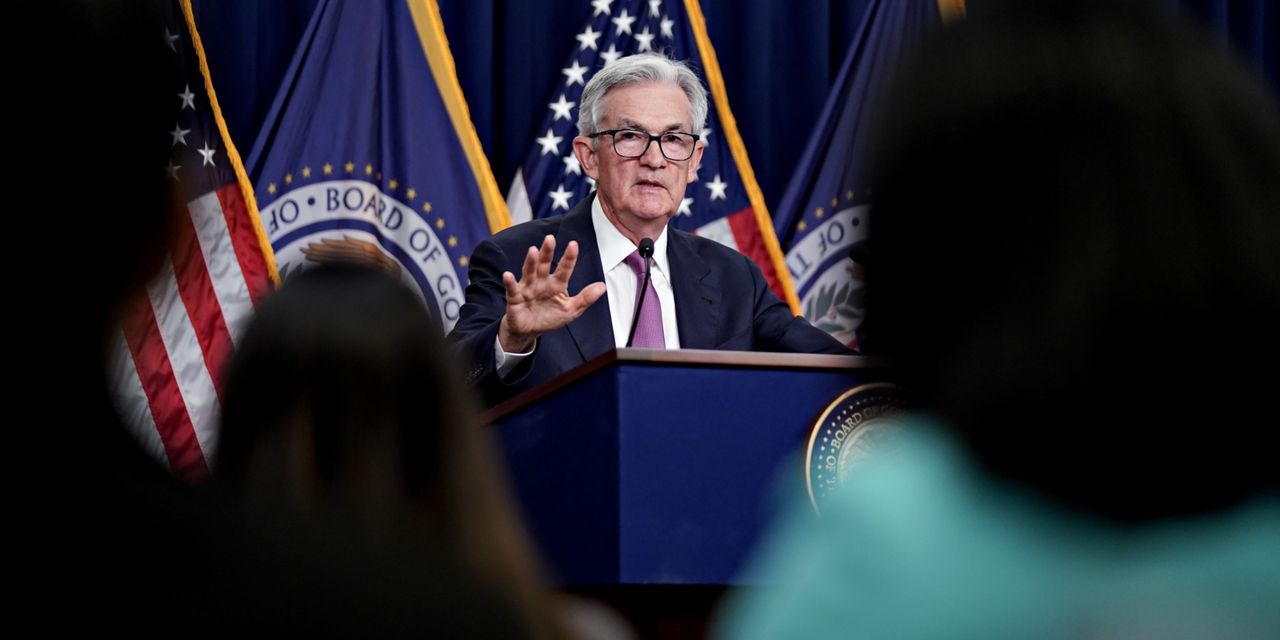
Federal Reserve Chairman Jerome Powell: The Fed’s inflation target of 2% is a longer way off than the market seems to think.
Sarah Silbiger/Bloomberg
“You cannot be serious!” With the beginning of Wimbledon, John McEnroe’s outbursts were ringing in my ears as the line umpires of economic data made their calls. Numbers that were deemed outside the lines didn’t look so bad upon further review.
The truly important ruling will come from the Federal Reserve when it holds its regular policy meeting the last week of July. Most economists and the market agree that another quarter-percentage-point increase in the federal-funds target, from the current 5% to 5.25% range, is likely after monetary authorities opted to hold their target unchanged at June’s meeting.
Chief among the conflicted data the Fed will need to consider is the Bureau of Labor Statistics’ June employment report released Friday morning. The 209,000 increase in nonfarm payrolls fell slightly short of economists’ consensus estimate of 230,000, a trivial miss but the first one after 14 straight upside beats of the key monthly jobs number. More substantively, the two prior months’ payroll tallies were revised down by a significant 110,000.
But the latest month’s payrolls weren’t boosted as much by the so-called birth-death adjustment, a statistical plug-in to reflect the assumed number of business start-ups and shutdowns. In June, this accounted for 26,000 of the one million-plus not-seasonally-adjusted June payroll increase, a negligible 3% of the total, writes Joshua Shapiro, chief U.S. economist at MFR. That contrasts with May, when the birth-death adjustment accounted for more than a quarter of the revised unadjusted payroll gain, and with April, when it represented 44% of the revised unadjusted increase.
The official seasonally adjusted private payrolls gain of 149,000 also came in far short of ADP’s estimate of 497,000 for June, released the day before. The tally from the private payroll processor has been much maligned for not matching the BLS numbers. But the outfit should have some handle on employment, since it cuts checks (or their electronic equivalent) for millions of real, live workers. ADP’s seasonal adjustment is what seems to need tweaking.
The workweek also ticked up, to 34.4 hours in June, an increase of one-tenth of an hour from May. Average hourly earnings were up 0.4% in the latest month, as were total hours worked. According to Evercore ISI, that meant incomes were up 0.8% in June and up a solid 6.3% from a year earlier.
Leading the general news coverage was a downtick of one-tenth in the headline unemployment rate, to 3.6%, and for the right reason: More Americans are holding jobs. What won’t likely get mentioned is a rise in the so-called underemployment rate, a broader measure of the labor market. That rose by 0.2 percentage point, to 6.9%, mainly because of an increase in those working part time because they didn’t find full-time gigs.
Even so, the labor market is strong and gives the Fed no reason to forgo further interest-rate increases. Overall employment in June was 2.5% above its prepandemic peak in February 2020, while private payrolls were 3.1% above that previous high-water mark, according to TLR Analytics. State and local government employment is a sore point, still 1.1% short of its prepandemic level.
The next key statistical hurdle for the market will be the June consumer price index, slated for release on Wednesday. The current line is for a 0.3% increase, both for the overall CPI and the core measure that excludes food and energy prices. Measured on a year-over-year basis, the core CPI is estimated to be up 5%, while the overall index would be up 3.1%. That latter modest gain, largely the product of the decline in retail gasoline prices, is certain to be highlighted by the Biden White House, since it represents a sharp deceleration from the four-decade high of 9.1% inflation.
But that is mainly a statistical anomaly, as Jim Bianco, the eponym of Bianco Research, has been emphasizing since early this year. Simply put, the year-over-year CPI change is being calculated against peak energy prices of last June. If the CPI were a corporate earnings report, it would be said to be facing tough comparisons.
This may be as good as it gets for core CPI, Bianco explained in a client presentation. If inflation reverts to the benign postfinancial-crisis trend of 2009-19, of average monthly rises of 0.16%, the year-over-year rise core CPI would still be 3.8% by the end of 2023, he calculates. Continuation of the more recent average of 0.4% monthly rises leaves year-over-year core CPI growth at over 5% at the end of the year.
Economists and the fed-funds futures market agree that the Fed will push up its key policy rate to 5.25% to 5.5% at the end of its next meeting on July 26. But while the monetary authorities’ median year-end expectation for the fed-funds target assumes another quarter-point increase, to a midpoint of 5.6%, the futures market is betting on no more increases after this month.
The latter would be consistent with general expectations of inflation making further progress toward the Fed’s 2% target. Bianco’s math suggests this is unlikely this year without a new plunge in oil prices. In that case, interest-rate markets would likely have to adjust further upward. The key Treasury two-year note yield poked above 5% briefly this past week, matching its previous high of last March, while the 10-year benchmark note broke out above 4%. Those are levels for investors to take seriously.
Write to Randall W. Forsyth at [email protected]
Read the full article here