



 English
 Français
 Deutsch
 Italiano
 Português
 Русский
 Español
 简体中文
简体中文 हिन्दी
 日本語
日本語
It may strike you that delving into Birkenstock with the stock market in turmoil is a tone-deaf, last-gasp-of-summer frivolity. Yet the circumstances of this maker of Teutonic-hippie-cum-hipster sandals are emblematic of what concerns not only culture vultures but also hardcore investors right now.
First and foremost is the likelihood of a Birkenstock public offering next month—barring a dramatic extension of the late-summer swoon. Beyond that, though, Birkenstock’s path forward speaks to consumer brands and trends, leverage ratios, the business of private equity, and the second-wealthiest man on the planet, to boot—if you’ll excuse the pun.
That this ancient footwear maker has managed to dodge initial-public-offering bankers, and their predecessors, for almost 250 years—since the first registered family shoemaker, Johann Adam Birkenstock, began cobbling in the burg of Langen-Bergheim near Frankfurt in 1774—is just one facet of the company’s remarkable story. That Birkenstock now looks to be going public, speaks not only to the persistence of bankers at Goldman Sachs and J.P. Morgan, who according to Bloomberg are working on an offering—both firms decline to comment—but also the irresistible power of the almighty dollar.
Yes, dollar not euro, because Birkenstock is looking to list in New York, since U.S. exchanges generally convey higher valuations, which, bankers hope, in the case of Birkenstock, will be up around $8 billion, or some five times annual revenue. Clearly, a valuation not for the faint of heart—or in this case, tender of foot.
Though the billionaire Birkenstock brothers Christian and Alex retain a 40% stake in the company, a majority is now controlled by—you guessed it—a private-equity firm, L Catterton, which is in the business of funding, buying, and selling consumer brands, including the likes of P.F. Chang’s,
Peloton Interactive
(ticker: PTON);
RH
(RH), the former Restoration Hardware; and, most recently, the “home run IPO” of online beauty company
Oddity
(ODD). L Catterton is singular beyond just its business focus. Co-founded in 1989 as Catterton-Simon Partners by leveraged-buyout pioneer and former Treasury Secretary William E. Simon, the firm changed its name to Catterton in 2001, a year after Simon died.
Even more salient, in 2016, Catterton merged with the PE arm of
LVMH Moët Hennessy Louis Vuitton
(LVMHF), the luxury behemoth controlled by Bernard Arnault, the world’s No. 2 rich guy (after Elon Musk). As such, the letter “L”—a nod to LVMH—was added to form L Catterton. Five years later, L Catterton, now with a personal investment from Arnault, bought Birkenstock for some $4.9 billion. L Catterton co-CEO Michael Chu joined Birkenstock’s board along with Arnault’s son Alexandre.
As a private-equity veteran said to me, the LVMH tie supercharges Birkenstock not only with capital but also with a luxury/consumer global network. A person close to Birkenstock highlighted the opportunity to grow in Asia, which is “still largely untapped.”
And, as I’m sure you know, Birkenstocks are hot. The once ugly-duckling therapeutic sandal (mit socks!) has become go-to footwear for the likes of Reese Witherspoon, Leonardo DiCaprio, Katy Perry, and Usher, and the company has collaborated with Dior, Manolo Blahnik, and Valentino. Birkenstock’s new plastic versions have been selling so briskly that it’s hard to find certain size/color combos.
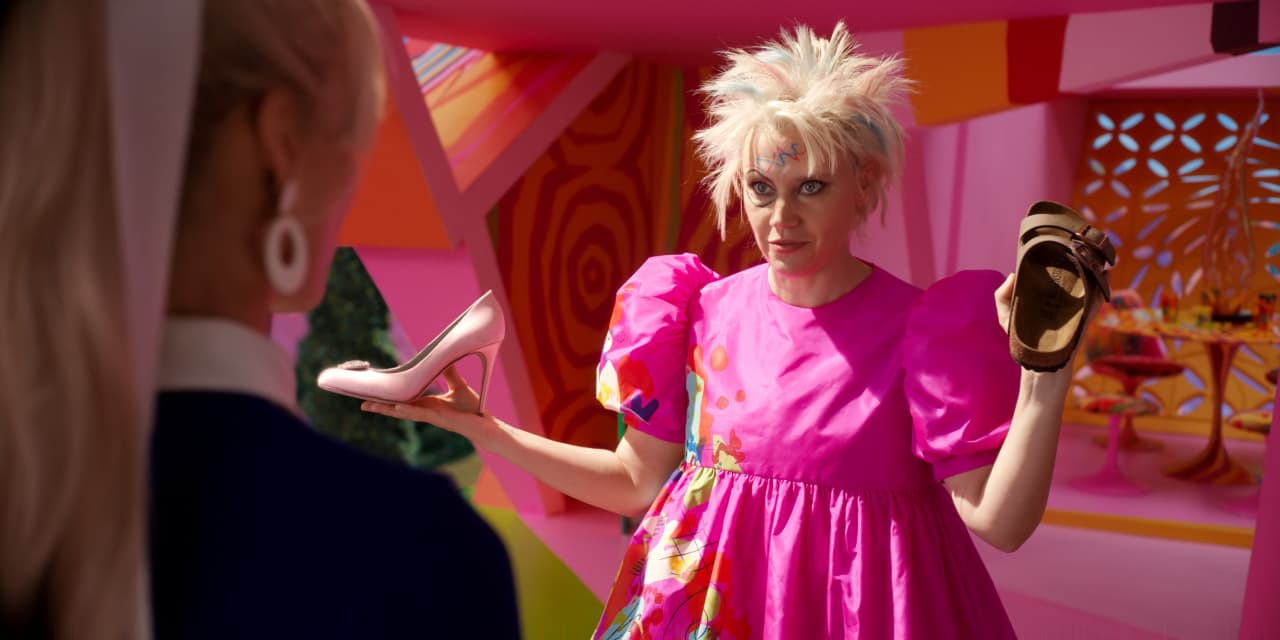
Then there was the auction of Steve Jobs’ brown suede Birkenstock Arizonas not long ago that fetched $218,000. And, as Jobs liked to say, just one more thing: Barbie! In case you missed it, Birkenstocks figure in a pivotal moment in that hit movie.
Leaving all of that aside, though, what are we to make of this company and its prospective IPO?
First, note that as stocks rallied this year, IPO bankers began dusting off names like Instacart and United Kingdom chip designer Arm, which are now ready for September’s IPO calendar. Others, like payments company Stripe, are reportedly waiting in the wings.
As for Birkenstock, L Catterton isn’t providing numbers, or commenting on the IPO, and the S-1 hasn’t been filed, but we can get a peek at some financials from Debtwire, which provides results for holders of the company’s publicly traded bonds. A June report shows Birkenstock’s net sales growing 19% year over year in the first half of 2023 to $704 million, while adjusted earnings before interest, taxes, depreciation, and amortization, or Ebitda, climbed 11%, to $245 million. According to a Birkenstock bondholder presentation, the company delivered a compounded annual growth rate of 22% in Ebitda and 18% revenue growth from 2018 to 2022. (Revenue for 2022: $1.34 billion.) Sales growth this year looks to be below trend, due to price hikes in previous years and constrained supply. The latter should be mitigated next month when Birkenstock opens a new factory.
The company does carry significant leverage, since the buyout was funded in part by $1.6 billion of high-yield debt, which was recently upgraded by Fitch and S&P, citing “high revenue and profit growth.” Birkenstock has paid down debt, but still has a gross leverage ratio of 4.3 times, which, Fitch notes, makes “Birkenstock’s credit profile weaker than that of
Levi Strauss
(LEVI), which also has is concentrated in one brand but is much greater in scale and more diversified by product. This, together with substantially lower leverage of below 3.5 times adjusted for leases, results in a higher rating for Levi Strauss.”
As for comparable companies, Crocs has a market capitalization of $5.8 billion, not far below what L Catterton and its bankers seek to get for Birkenstock, yet Crocs has over $3.5 billion in annual revenue and is worth 1.6 times revenue, far less than what the bankers hope Birkenstock is worth.
Morningstar analyst Jelena Sokolova likes the Birkenstock business but thinks that the IPO “valuation looks on the high side,” especially when she compares it with a footwear company like
Dr. Martens
(DOCS.UK) “which now has a market cap of $1.9 billion on a comparable revenue.”
Grizzled Up & Downers are undoubtedly aware that with the shining exception of
Nike
(NKE), footwear companies in all of their variants—retailers, manufacturers, fashion lines—generally haven’t made for winning investments. Recall that Warren Buffett’s “worst deal” was for Dexter Shoe.
And yet, betting against Birkenstock is tantamount to wagering against Arnault. That’s a call I wouldn’t want to make.
Write to Andy Serwer at [email protected]
Read the full article here