



 English
 Français
 Deutsch
 Italiano
 Português
 Русский
 Español
 简体中文
简体中文 हिन्दी
 日本語
日本語
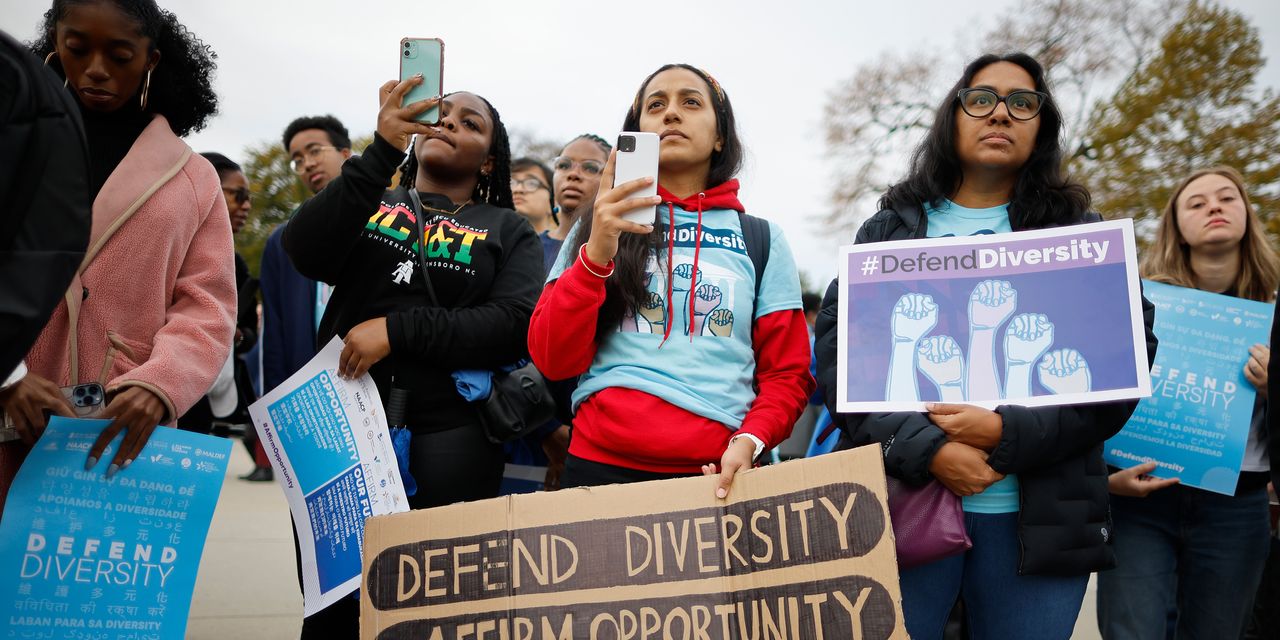
The Supreme Court voted to end affirmative action in college admissions Thursday. And the momentous decision and its implications for higher education began playing out in the court of public opinion soon afterward.
Some like former first lady Michelle Obama and the president of the NAACP expressed concern that overturning affirmative action will crush decades of progress. President Joe Biden said the ruling must not be “the last word.” But others, including former President Donald Trump, called the decision to end race-conscious college admissions programs “a great day for America.”
The Supreme Court’s conservative majority ruled to overturn the admissions plans at Harvard and the University of North Carolina, the nation’s oldest private and public colleges, respectively. Chief Justice John Roberts said that universities have “concluded, wrongly, that the touchstone of an individual’s identity is not challenges bested, skills built, or lessons learned but the color of their skin. Our constitutional history does not tolerate that choice.”
And Justice Clarence Thomas, the nation’s second Black justice who had long called for an end to affirmative action, wrote separately that the decision “sees the universities’ admissions policies for what they are: rudderless, race-based preferences designed to ensure a particular racial mix in their entering classes.”
Read more: Supreme Court rules against affirmative action at universities
But the counter arguments from the liberal dissenters on the Supreme Court bench, including Justice Sonia Sotomayor, expressed concern that the decision “rolls back decades of precedent and momentous progress.”
And the debate appeared to be similarly split along party lines in the commentary that came out across social media and in official statements.
Former President Trump shared a Truth Social post saying that this ruling would lead to school acceptances being “all merit-based,” and “it will also keep us competitive with the rest of the world.”
”People with extraordinary ability and everything else necessary for success, including future greatness for our Country, are finally being rewarded,” he wrote.
U.S. Senate Minority Leader Mitch McConnell called the ruling “a long-overdue step toward ensuring equal protection under the law.”
The Republican from Kentucky added that, “Today’s rulings make clear that colleges may not continue discriminating against bright and ambitious students based on the color of their skin.”
Congresswoman Elise Stefanik, a New York Republican, called the ruling “a major victory for the American Dream and all students,” adding, “every individual has the opportunity to succeed, regardless of background or race.
But many of those mourning the end of affirmative action in college and university admissions said quite the opposite: that this could make an already uneven playing field even worse.
President Biden said colleges “should not abandon their commitment to ensure student bodies of diverse backgrounds and experience that reflect all of America.” He added that colleges and universities should take into account “the adversity a student has overcome” when selecting among applicants.
Former first lady Obama shared a statement reading that, “my heart breaks for any young person out there who’s wondering what their future holds — and what kinds of chances will be open to them.”
And she noted that ending affirmative action isn’t the end of the college admissions process giving special considering to some students over others.
“So often, we just accept that money, power, and privilege are perfectly justifiable forms of affirmative action,” she added, “while kids growing up like I did are expected to compete when the ground is anything but level.”
NAACP president and CEO Derrick Jackson called out Justice Clarence Thomas (who voted against affirmative action) while speaking on MSNBC on Thursday. Jackson said that, “The worst thing about affirmative action is that it created a Clarence Thomas who benefited from the program and now is in a position where he’s going to deny many young African American talented individuals an opportunity.”
Bernice King, the daughter of Civil Rights icon Martin Luther King Jr., shared a statement from the King Center’s Twitter feed saying that, “We should not need affirmative action. But we do. Because racism, particularly anti-Black racism, persists in this nation’s systems, policies, and institutions.”
Sen. Cory Booker, a Democrat from New Jersey, called the SCOTUS decision “a devastating blow to our education system across the country,” adding that affirmative action “has been a tool to break down systemic barriers.”
Celebrated author Joyce Carol Oates also noted that ending affirmative action “would make complete sense if all public high schools throughout the entire country were more or less equal in quality, but there is a wide range from impoverished to ultra-affluent,” she wrote. “So students applying to universities are not on an equal footing” — especially compared to legacy students whose parents or grandparents are alumni or generous donors to a school.
Running up to the Supreme Court vote, survey data from the Pew Research Center found that half of U.S. adults (50%) disapproved of colleges and universities taking prospective students’ racial and ethnic backgrounds into account when making admissions decisions. That’s in comparison to one in three (33%) approving of colleges considering race and ethnicity to increase diversity at the schools, while 16% said they were not sure.
For more about the Supreme Court ruling on affirmative action, check out these MarketWatch stories:
As Supreme Court strikes down affirmative action, the push to end legacy admissions may gain momentum
How college admissions will change in America after the Supreme Court knocked down affirmative action
The Associated Press contributed.
Read the full article here